
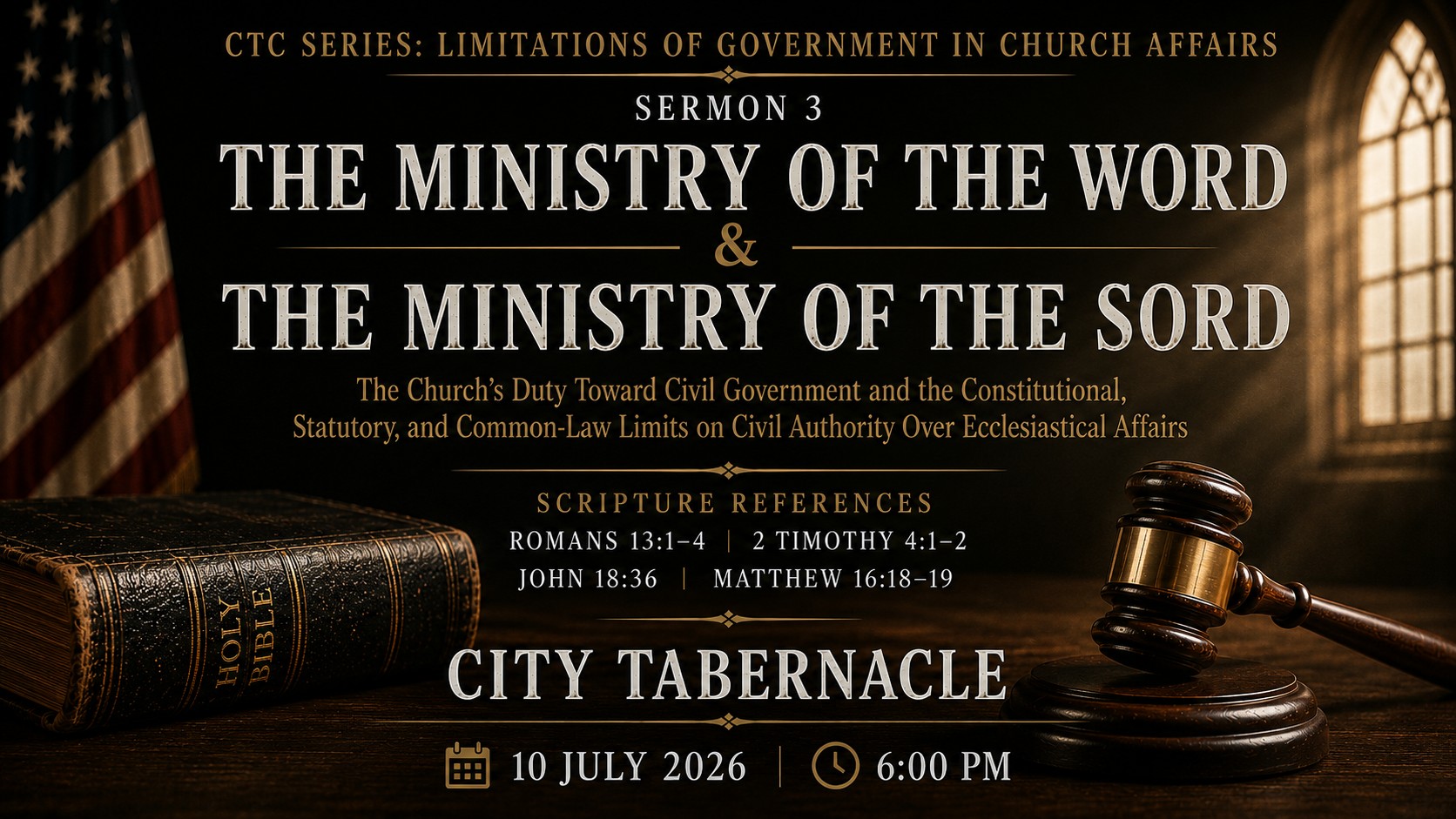
Sermon Three: The Ministry of the Word & The Ministry of the Sword
Christ established two distinct ministries, each ordained by God for a different purpose. Civil government bears the sword to preserve justice, restrain evil, and maintain public order, while Christ entrusted His church with the ministry of the Word to proclaim the gospel, shepherd souls, and advance His eternal kingdom. This message explores the biblical, historical, constitutional, and common-law boundaries that preserve both institutions from jurisdictional overreach. Through Scripture, the wisdom of the American Founders, state constitutions, and lessons from church history, we discover that liberty flourishes only when Caesar remains within his God-given jurisdiction and the church faithfully fulfills hers. The sermon concludes by lifting our eyes above every earthly kingdom to Christ, whose reign alone is everlasting.
Topic Outline
- God-Ordained Jurisdictions
- The Purpose of the Civil Sword
- The Authority of the Church
- Christ Before Pilate
- The Temptation to Confuse Jurisdictions
- Constitutional Safeguards for Religious Liberty
- Christ Outlives Empires
THE CHURCH AND CIVIL GOVERNMENT
Sermon One of Twenty-One
THE MINISTRY OF THE SWORD AND THE MINISTRY OF THE WORD
Primary Texts: Romans 13:1-4; 2 Timothy 2:1-2; John 18:36; Matthew 16:18-19
Preached 10 JUL 2026 | City Tabernacle | 1800
David J Cro, Pastor
————————————————————————
THE PERIL OF CONFUSED OFFICES
There are certain distinctions which God Himself has established, and whenever men have forgotten them, whether through pride, fear, impatience, or that ancient lust by which the creature desires to occupy the throne of the Creator, confusion has followed close behind, for the Lord never intended the family to become the church, nor the church to become the state, nor the state to become the sanctuary, and He certainly never intended Caesar, whether robed in purple, clothed in a black judicial robe, seated behind a council desk, or speaking through an administrative office, to become bishop over the household of God. Genesis 2:24; Matthew 16:18-19; Romans 13:1-4; 1 Timothy 3:15.
Last we spoke of the limitations of the Civil Government and its Interference in the Church’s Affairs, we considered two kingdoms and two jurisdictions. We observed that God has established civil government for one purpose and His church for another, and that disorder begins whenever either sphere becomes dissatisfied with the office assigned to it. Yet distinctions, however necessary, eventually require instruments. It is one thing to confess that church and state occupy different provinces beneath the sovereignty of God; it is another thing altogether to ask what God has placed into Caesar’s hand, and what He has reserved unto His church.
I have lived long enough to learn that much of the misery which troubles both church and nation arises not because authority exists, but because authority forgets itself. Families suffer when fathers become tyrants. Churches suffer when shepherds become princes. Nations suffer when rulers imagine themselves to be saviors. And souls suffer most grievously when men become convinced that every human problem may be solved by the multiplication of civil power, as though a statute could regenerate a sinner, an ordinance could sanctify a conscience, or a magistrate’s order could accomplish what the Spirit of God Himself alone has promised to perform. Psalm 146:3; John 3:5-8; 2 Corinthians 3:17-18.
The Apostle Paul, writing beneath the shadow of Rome itself, says, “For he is God’s servant for your good. But if you do wrong, be afraid, for he does not bear the sword in vain” (Romans 13:4). It is remarkable that Paul, in describing the magistrate, does not speak of preaching, sacraments, membership, discipline, ordination, or the shepherding of souls. He speaks of a sword — the machaira, the instrument of civil restraint and judgment, not the instrument of spiritual redemption. That choice was not accidental, for the Holy Spirit selected that image with perfect wisdom. The sword represents a ministry: a necessary ministry, a fearful ministry, a ministry without which fallen society would quickly dissolve into vengeance and violence, but not a redemptive ministry. The sword may restrain the hand, but it cannot renew the heart; it may punish the thief, but it cannot justify the sinner; it may guard the peace of streets, courts, and homes, but it cannot open the kingdom of heaven.
Therefore our question tonight is not whether government is good or evil, for the Scripture has already answered that civil authority is God’s servant when it remains within its appointed work; nor is our question whether the church may speak concerning righteousness, for prophets, apostles, and martyrs have answered that she must. Our question is whether servants shall remain content with the ministries God Himself assigned unto them, whether the magistrate shall be content with the sword and the church content with the Word, and whether both shall remember that every borrowed office must someday answer before the unborrowed throne of Jesus Christ.
THE SWORD ENTRUSTED TO THE CIVIL MAGISTRATE
Let no Christian speak lightly of civil government, for anarchy is not liberty and lawlessness is not freedom. Imagine a world without judges, without lawful officers, without courts, without public order, without any civil remedy for violence, theft, fraud, or oppression; such a world would not be paradise, but misery with no appeal, a dark marketplace where the strong devour the weak and every grievance becomes an invitation to revenge. Paul understood this, and therefore, even beneath pagan Rome, he could call the magistrate God’s servant, not because Rome was righteous, and not because Nero was righteous, but because God in His common mercy has ordained civil authority for the restraint of public evil among sinful men. Romans 13:1-7; 1 Peter 2:13-17.
We ought therefore to thank God for every honest judge who loves justice more than applause, for every officer who quietly places himself between order and chaos, for every legislator who remembers that law is not clay for ambition but a trust beneath heaven, and for every public servant who understands that authority is not a possession to be enjoyed but a stewardship to be rendered back unto God. These are not enemies of liberty; when rightly ordered, they are among liberty’s earthly guardians.
Yet the very dignity of the magistrate makes his trespass more dangerous when he forgets his bounds. A private citizen who misunderstands the church may be mistaken; a civil officer who undertakes to govern the church has converted mistake into usurpation. When the magistrate moves from punishing crimes to measuring ministry, from protecting public order to supervising doctrine, from enforcing neutral civil obligations to determining whether worship is sufficiently regular, visible, useful, convenient, or pleasing to administrative expectation, he has not merely stepped upon unfamiliar ground; he has crossed a boundary over which Christ Himself has set a warning. The sword was never given to count faithfulness. It was never given to certify the presence of Christ among His people. It was never given to dictate the ministry of Word, sacrament, discipline, membership, pastoral care, or ecclesiastical government.
The older writers understood what modern bureaucratic speech often conceals. Power, even when polite, remains power; and power, when exercised beyond jurisdiction, becomes a species of theft, for it takes into its own hand an authority never granted by God. Samuel West spoke of rulers as trustees, not proprietors, of authority. Blackstone taught that human law draws its authority from higher law and becomes corrupt when it abandons that order. Madison declared that religion is directed only by reason and conviction, not by force or violence. These men were not merely ornamenting political theory; they were bearing civil witness to a theological truth: no magistrate owns the conscience, because no magistrate created the soul.
THE KEYS AND THE WORD ENTRUSTED TO THE CHURCH
The same God who ordained civil government also established His church, and He did not leave her wandering as an accidental association, dependent upon the permission of kings, legislatures, assessors, courts, councils, or administrative officers. The church is older than republics, older than Wisconsin, older than America, older than every present constitution upon the earth, and she shall outlive them all, for she was not born in Congress, chartered by a state, founded by a municipality, or called into being by a court decree. Before there was a Senate, before there was a governor, before there was a county, before there was a city, there stood the Son of God among His disciples saying, “I will build my church, and the gates of hell shall not prevail against it” (Matthew 16:18).
I confess that I love those words more with every passing year. In youth, I loved them because they sounded triumphant; now, with more years behind me and fewer illusions concerning the strength of man, I love them because they sound restful. Our Lord did not say that kings would build His church, or courts preserve His church, or constitutions sustain His church, or favorable administrations secure His church. He said, “I will build my church” (Matthew 16:18). And after nearly two thousand years, the promise remains tonight exactly as it was when it first fell from His lips.
Having spoken of His church, our Lord immediately spoke of keys. Not swords. Keys. “I will give you the keys of the kingdom of heaven” (Matthew 16:19). Keys do not belong to battlefields, but to households; they do not wound, they open; they do not compel, they admit and exclude according to the authority of the householder. Christ entrusted those keys not unto Caesar but unto His church, and by those keys the church declares the gospel, receives the penitent, warns the impenitent, exercises discipline according to the Word, and bears witness that entrance into the kingdom is by Christ alone. Matthew 16:19; Matthew 18:15-20; John 20:21-23.
Therefore, when the church opens the Scriptures, preaches Christ crucified and risen, baptizes believers, breaks bread in remembrance of the Lord, receives members, disciplines sin, ordains ministers, calls elders, teaches the whole counsel of God, and gathers the saints in worship, she is not performing merely social services beneath the indulgence of the civil power; she is exercising a ministry given by Christ Himself. The magistrate may protect the peace in which these things occur, and he may enforce civil laws of general application upon civil matters properly within his jurisdiction, but he may not transform himself into the examiner of spiritual sufficiency. He may inspect a furnace for safety; he may not inspect a sermon for orthodoxy. He may enforce fire codes in the assembly hall; he may not declare whether the assembly is faithful. He may record deeds and parcels; he may not measure the life of the body of Christ by the habits of his clipboard.
THE SIN OF JURISDICTIONAL USURPATION
Here, then, we must speak plainly, for soft words are sometimes the servants of cowardice. When civil magistrates presume to govern the internal affairs of Christ’s church, whether by direct command or by administrative pressure, whether with a mailed notice, an official letter, a conditional benefit, a licensing scheme, a discriminatory burden, a hostile inquiry, or an officious demand that sacred things submit to secular definitions, they commit a moral infraction more serious than procedural irregularity. They trespass upon jurisdiction. They invade an office not given to them. They behave as though the sword were competent to hold the keys.
This sin may appear in grand forms, when kings claim supremacy over churches, and it may appear in small forms, when local officers, under color of administrative duty, attempt to decide whether a congregation’s ministry is sufficiently active, whether its worship is sufficiently visible, whether its pastoral work is sufficiently measurable, whether its spiritual use of property conforms to the ordinary expectations of civic management, or whether Christ’s people have gathered in ways comprehensible to the civil eye. The scale may differ, but the principle does not. A city council does not become bishop by speaking in minutes rather than miters. An assessor does not become elder because his inquiry wears the garments of taxation. A county official does not receive the keys because his office is practical and his language secular.
There is a civil sphere, and the church ought not deny it. Buildings may burn, roads may be obstructed, neighbors may be harmed, contracts may be breached, crimes may be committed, and civil government may rightly address those civil matters according to lawful authority. But when the civil officer begins to ask not whether a structure is safe, but whether ministry is real; not whether a public nuisance exists, but whether worship has occurred often enough; not whether a deed is valid, but whether the household of faith has used its property in a manner pleasing to secular judgment, then the sword has wandered from its scabbard and entered the sanctuary.
The evil of such usurpation is not that government asks questions; government must sometimes ask questions. The evil is that it forgets what kinds of answers it is competent to judge. Civil authority may determine ownership, taxation, zoning, safety, fraud, and public peace within constitutional limits, but it cannot determine the presence of the Spirit, the adequacy of preaching, the sufficiency of pastoral visitation, the spiritual character of prayer meetings, the ecclesiastical weight of membership, or the faithfulness of a congregation whose Lord Himself may be walking among the lampstands while the civil eye sees only dim lights and irregular schedules. Revelation 1:12-20; Revelation 2:1.
Let the magistrate beware. It is a fearful thing for a public servant, who holds a temporary office under a borrowed authority, to place his hand upon the ark of Christ’s jurisdiction and suppose that good intention will sanctify unauthorized touch. The Lord is patient, but He is not indifferent; He is merciful, but He is not mocked. Civil authority may be necessary, useful, and honorable, but it is never ultimate, and when it presumes to supervise Christ’s church as though the bride belonged to the courthouse, the council chamber, or the administrative file, it has forgotten both its origin and its end. Such presumption may arrive with polished manners and respectful phrases, but courtesy does not cure usurpation, and a soft voice does not cleanse an unlawful claim of power.
THE EQUAL WARNING TO CHURCH AUTHORITIES
Yet the warning must also turn toward the church, for governments are not the only institutions tempted by forbidden power. Pastors, elders, churches, denominations, and religious movements may also grow impatient with the slow and holy methods of Christ. We are tempted to envy the sword because the sword appears efficient, immediate, visible, and feared, while preaching appears weak, discipline painful, prayer hidden, repentance slow, and holiness, in many seasons, almost invisible to the impatient eye.
Perhaps nowhere is that temptation seen more clearly than beneath the olive trees of Gethsemane. I try not to judge Peter too harshly, for I suspect I know him better than I wish to confess. There is something in us that prefers quick victory to obedient suffering, something that mistakes zeal for faith, something that imagines the kingdom will be safer if only we may seize the weapons of men for the defense of the purposes of God. Then our Lord answered with words that ought to echo through every century of church history: “Put your sword back into its place” (Matthew 26:52).
Even good men may sin by defending right things with wrong instruments. Truth does not require violence. Grace does not require coercion. The gospel does not require the machinery of compulsion. If twelve legions of angels were unnecessary to preserve the Son of God, then surely Peter’s sword was unnecessary as well. Christ did not conquer by taking life, but by laying down His own; He did not establish His reign by coercing submission, but by bearing witness to truth, shedding His blood, rising from the dead, and sending forth His Word in the power of the Spirit. Matthew 26:52-54; John 10:17-18; John 18:37; Acts 1:8.
How often has the church forgotten this? Influence becomes privilege; privilege becomes dependence; dependence becomes control; and before long the church that once asked Caesar for protection discovers that the same sword which promised shelter now demands obedience. Every time the church exchanges the cross for worldly power, she diminishes her witness; every time she seeks coercion where Christ commands persuasion, she obscures the beauty of her Lord; every time she trusts princes more than providence, she discovers that earthly strength is a poor substitute for the Holy Spirit.
Thus we must maintain both judgments together. The magistrate sins when he reaches for the keys, and the church sins when she reaches for the sword. Civil officers must not govern doctrine, worship, discipline, ministry, membership, or ecclesiastical office; church officers must not manipulate the state into becoming an arm of spiritual coercion. Let the ruler punish crime, preserve public peace, and administer justice under God; let the pastor preach the Word, shepherd the flock, administer discipline, and suffer patiently for Christ. Neither office is dishonored by limitation. Each is honored when it remains obedient.
THE JUDGMENT HALL: CHRIST BEFORE PILATE
If there is one scene in all of Holy Scripture that reveals these truths most beautifully, it is not found in Rome’s senate, nor in England’s courts, nor in Philadelphia’s convention hall, but in a Roman judgment hall where the visible representative of the mightiest empire on earth sat upon a tribunal, while before him, bruised and accused, stood One whose kingdom would outlive Rome itself. Pilate possessed soldiers, courts, seals, records, authority, and the awful machinery of execution; Christ stood apparently helpless, abandoned by friends, condemned by religious accusers, and delivered into the hands of civil power. To every eye trained by earthly spectacle, the outcome seemed obvious. Yet appearances have always been poor theologians.
The Man standing before Pilate was no ordinary prisoner. He was the One by whom kings reign and princes decree justice. He was the One of whom Isaiah had written, “And the government shall be upon his shoulder” (Isaiah 9:6). Pilate imagined that he sat in judgment over Christ, but the day would come when Pilate himself would stand before Christ. Rome itself would sink beneath the feet of time, but the Nazarene would be worshiped in tongues Pilate never heard, in lands Rome never ruled, by peoples whose children would know the governor chiefly because, for one dreadful hour, he questioned the King.
When Pilate questioned Him concerning His kingdom, our Lord answered, “My kingdom is not of this world” (John 18:36). These words have often been misunderstood, as though Christ meant that His kingdom has nothing to do with the world, or that His church must remain silent concerning righteousness, truth, justice, mercy, marriage, life, worship, conscience, and the moral law of God. But our Lord said no such thing. He did not say His kingdom was not in this world; He said it was not of this world. Its origin is heavenly. Its authority is divine. Its weapons are spiritual. Its life does not depend upon elections, appropriations, permits, charters, administrative favor, or the permission of Caesar.
When Pilate boasted of authority, our Lord quietly answered, “You would have no authority over me at all unless it had been given you from above” (John 19:11). There, in one sentence, Christ both acknowledged and humbled the civil office. Pilate had real authority — exousia, a delegated and accountable authority — and Christ did not deny it. But Pilate’s authority was given, which means it was borrowed, bounded, accountable, temporary, and subject to judgment. Every magistrate who hears these words should tremble with holy sobriety, for the same Christ who stood before Pilate now sits enthroned above every court, council, legislature, agency, and executive office upon earth.
THE AMERICAN CONSTITUTIONAL WITNESS TO ORDERED LIBERTY
America did not create this doctrine, for Christ’s church had already learned it beneath emperors, kings, councils, prisons, martyr fires, and missionary fields; yet at its best, the American constitutional order bears civil witness to it. The First Amendment forbids Congress from making law respecting an establishment of religion or prohibiting the free exercise thereof, and by the Fourteenth Amendment those limits restrain state and local governments as well. The meaning is not that religion is irrelevant to public life, nor that the church must be silent before civil wrong, but that civil government is denied lordship over the religious conscience and forbidden to seize ecclesiastical office.
The Wisconsin Constitution speaks with a solemn beauty well suited to this subject: “The right of every person to worship Almighty God according to the dictates of conscience shall never be infringed.” Never is a mighty word. Not generally. Not when officials are comfortable. Not when religious practice appears administratively tidy. Not when worship conforms to ordinary civic assumptions. Never. And because Wisconsin municipalities possess delegated and limited powers, their councils, officers, boards, clerks, assessors, inspectors, and administrators cannot acquire spiritual jurisdiction by local ordinance, administrative custom, or practical convenience.
This is not hostility to government; it is the moral condition of lawful government. A city is not dishonored because it cannot ordain pastors. A county is not weakened because it cannot define worship. A state is not diminished because it cannot command doctrine. The federal government is not injured because it cannot regulate the keys of the kingdom. Civil power is strongest when it is humble enough to remain civil, and the state becomes most dangerous when, having forgotten the modesty proper to delegated authority, it attempts to transform public administration into spiritual oversight.
UNITED STATES CASE LAW AND THE BOUNDARIES OF THE SWORD
Even the case law of the United States, imperfect and changing though all human judgments are, has often borne witness to these jurisdictional limits. We must not make court opinions our Bible, for the church stands upon the Word of God and not upon the shifting pages of reporters; yet when the civil law itself recognizes that there are regions into which the state may not enter, Christians may receive that recognition with gratitude, while remembering that the truth was true before the opinion was written and will remain true if a later court forgets it.
In Cantwell v. Connecticut, the Court held that religious solicitation could not be subjected to a system in which an official determined whether a cause was religious before allowing it to proceed. In Murdock v. Pennsylvania and Follett v. Town of McCormick, the Court rejected municipal license taxes as applied to the distribution of religious literature and the work of an evangelist. These cases do not mean that every religious person is free from every civil duty; they mean that the city may not place a tollgate before religious proclamation and then call the tollgate mere administration.
Other cases speak more directly to the church’s internal government. In Kedroff v. St. Nicholas Cathedral, the Supreme Court rejected a state effort that interfered with hierarchical church authority, recognizing that religious organizations must remain free to decide matters of church government, faith, and doctrine. In Serbian Eastern Orthodox Diocese v. Milivojevich, the Court refused to let civil tribunals second-guess ecclesiastical decisions concerning discipline and church administration. In Hosanna-Tabor Evangelical Lutheran Church and School v. EEOC and Our Lady of Guadalupe School v. Morrissey-Berru, the Court recognized that the First Amendment protects the church’s freedom to select and supervise those who carry out its religious mission. Such holdings are not favors bestowed upon the church by a generous state; they are civil acknowledgments that the sword was never given authority to choose the servants of the Word.
There are cases also in which government hostility or unequal treatment has been rebuked. In Church of the Lukumi Babalu Aye v. City of Hialeah, ordinances targeting religious practice could not survive constitutional judgment. In Masterpiece Cakeshop, official hostility toward religious conviction corrupted the civil process. In Trinity Lutheran, Espinoza, and Carson, the Court rejected forms of public exclusion that penalized religious identity or religious use when government opened benefits more broadly. These cases, taken together and rightly limited, teach that the state may neither punish religion for being religious nor disguise disfavor as neutrality.
Yet let us speak carefully. These decisions do not make the church sovereign in the place of God, nor do they place religious institutions above every civil law. They do not give pastors permission to commit fraud, churches permission to endanger neighbors, or congregations authority to convert spirituality into a cloak for civil wrong. Rather, they recognize a principle much older than America: civil government may govern civil incidents within its lawful jurisdiction, but it may not seize the church’s spiritual office, supervise her doctrine, dictate her worship, control her ministers, license her proclamation, or punish her because her work is religious.
THE MINISTRY OF THE WORD IN AN AGE DRUNK ON POWER
For God gave Caesar a sword, but He gave His church something infinitely greater: His Word. Had redemption been entrusted to the wisdom of men, we would have arranged matters very differently. We would have trusted influence, wealth, machinery, prestige, celebrity, strategy, cultural dominance, and visible strength. But God, whose wisdom forever humbles the wisdom of men, chose preaching. Week after week, a congregation gathers; hymns are sung; prayers are offered; a Bible is opened; an ordinary man stands and speaks; and to the eyes of the world there appears to be nothing particularly impressive about any of it. No armies march. No decrees are issued. No court publishes an opinion. No headline announces the quiet work of grace. Yet heaven bends its ear toward such things.
Near the end of his earthly pilgrimage, Paul did not charge Timothy to master the instruments of empire, secure permanent favor with princes, or substitute civil influence for spiritual faithfulness. He said, “Preach the word; be ready in season and out of season; reprove, rebuke, and exhort, with complete patience and teaching” (2 Timothy 4:2). Empires issue decrees. Governments command armies. Courts publish judgments. Councils pass ordinances. But the church preaches. What weakness this appears to be before the modern mind, and yet Augustine’s books outlived Rome, Luther’s sermons shook Europe, Bunyan’s prison-born witness continues speaking, Whitefield crossed oceans with a Bible and a voice, and ordinary saints whose names the world never knew have carried the Word of God from generation to generation.
I have seen enough saints buried to know something. Very few speak of politics at the end. Very few speak of influence. Very few speak of famous men. They speak of Christ. They speak of promises. They speak of hymns learned in childhood, Scriptures hidden in the heart, sins forgiven, prayers answered, mercies undeserved, and the hope of resurrection. I have often left such rooms thinking that ordinary means are not ordinary after all, that heaven places a greater value upon prayers than governments do, that the tears of a grandmother may matter more than speeches of princes, and that little congregations gathered around an open Bible are participating in something angels themselves delight to behold.
Tyrants understand armies. They understand wealth. They understand force. They understand fear. But they do not understand prayer, hope, repentance, worship, and songs sung in suffering. You may imprison a preacher, but you cannot imprison truth. You may confiscate property, but you cannot confiscate hope. You may silence a voice, but you cannot silence the Word of God. You may destroy a building, but you cannot destroy the church that Christ Himself has promised to build.
No election has ever regenerated a soul. No legislature has ever produced revival. No court has ever converted a sinner. No municipal ordinance has ever raised the spiritually dead. Good laws matter, righteous rulers are blessings, civil order is a mercy, and public justice is not to be despised; but Pentecost never depended upon Pilate, and the kingdom never advanced because Caesar granted permission. It advanced because Christ poured out His Spirit, and He has never ceased doing so. Acts 2:1-47; Zechariah 4:6; John 6:63.
SUBMISSION WITHOUT SURRENDER
The apostles were not anarchists, and neither should we be. These same men who said, “We must obey God rather than men” (Acts 5:29), also taught believers to honor the emperor, pray for kings, live quietly, do good, and submit to lawful authority under God. Submission and surrender, however, are not the same thing. Submission is obedience to lawful authority within its God-given jurisdiction. Surrender is the abandonment of God’s authority in order to appease men. The apostles understood the difference, and therefore they could stand before rulers without hatred, without malice, without rebellion in the vulgar sense, and yet with immovable firmness.
This distinction is necessary in every age, but especially in an age that confuses disagreement with disorder and conscience with defiance. The church must not be petulant. She must not become theatrical in resistance, eager for injury, careless with truth, or quick to baptize personal inconvenience as persecution. But neither may she bow where Christ has commanded her to stand. When government commands what God forbids, forbids what God commands, or claims authority over what Christ has reserved to His church, obedience to God becomes not an option for the dramatic but the duty of the faithful.
Madison wrote that the duty owed to the Creator is precedent in order and superior in obligation to the claims of civil society. In Christian language, before there is citizenship, there is creaturehood; before there is government, there is God; before there are constitutions, there is conscience; before any man belongs to Caesar, he belongs to the Lord who made him. Therefore the church prays for rulers, honors lawful authority, seeks peace, pays what is due, speaks truth without contempt, and refuses to surrender the keys Christ gave into her hands. Matthew 22:21; Romans 13:7; 1 Timothy 2:1-2; Acts 5:29.
THE TEMPORARY SWORD AND THE EVERLASTING WORD
We must end where Scripture ends: not in fear, not in resentment, not in despair concerning the age in which we live, but in hope. Every generation is tempted to believe that its troubles are unprecedented, that its rulers are uniquely dangerous, that its confusions have never before been seen beneath the sun. Yet the saints before us have lived beneath emperors, suffered beneath kings, worshiped in catacombs, preached from prison cells, buried martyrs, endured confiscations, crossed oceans for conscience, and learned through tears that Christ remains faithful when every earthly shelter trembles.
This church of our Lord is older than America. She is older than Wisconsin. She is older than the Constitution. She is older than every present nation of the earth, and should the Lord tarry, she shall outlive them all. Assyria passed away. Babylon passed away. Greece passed away. Rome passed away. Kingdoms that once terrified the world now occupy little more than pages in history books, while somewhere this very hour saints gather in the name of Jesus Christ and heaven recognizes them as citizens of a kingdom that cannot be shaken. Hebrews 12:28; Revelation 5:9-10.
The sword itself is temporary, because the conditions that require it are temporary. Sin made magistrates necessary; glory will make them obsolete. Isaiah saw the day when men “shall beat their swords into plowshares, and their spears into pruning hooks” (Isaiah 2:4). Think of it: the ministry of the sword, necessary as it is in this fallen age, shall one day come to its appointed end. But “The grass withers, the flower fades, but the word of our God will stand forever” (Isaiah 40:8). The Word that created, called, promised, judged, redeemed, sanctified, and raised the dead will remain when every earthly decree has turned to dust.
One day every throne shall surrender its borrowed glory before the Lamb who was slain. Kings and judges, governors and councilmen, legislators and officers, pastors and bishops, citizens and strangers, rich and poor, famous and forgotten, shall stand together as creatures before their Creator. Then no office shall be flattered, no usurpation excused, no conscience coerced, no faithful suffering wasted, no hidden ministry forgotten. The question in that day shall not be whether we possessed power, but whether we were faithful beneath the power we possessed.
Therefore let every ruler remember his limits. Let every pastor remember his charge. Let every church remember her mission. Let every conscience bow before God alone. Let every citizen honor lawful authority without making an idol of civil power. Let every magistrate take heed lest he punish what God approves or approve what God condemns. Let the sword remain the sword, and let the Word remain the Word, until the day when the sword is no longer needed and the Word shines openly in the everlasting kingdom of Christ.
The One who stood before Pilate now reigns above Pilate. The One who wore the crown of thorns now wears many crowns. The One who bore the cross has conquered the grave. The One who promised, “I will build my church” (Matthew 16:18), still walks among the lampstands. The One who holds the keys of Death and Hades neither slumbers nor sleeps. The One before whom every king shall bow, every judge shall answer, every pastor shall give account, and every conscience shall stand exposed, is Jesus Christ, King of kings and Lord of lords. Revelation 1:17-18; Revelation 19:16; Hebrews 13:17.
And unto Him, who alone is Head of the church, Lord of the conscience, Judge of the nations, and Savior of sinners, belong both the sword and the Word, in their proper order and beneath His everlasting throne, forever and ever.
Amen.
PART III – REFERENCES
- The Holy Bible, English Standard Version. Crossway, 2016.
- Romans 13:1-7.
- Matthew 16:18-19.
- Matthew 18:15-20.
- John 18:36-37.
- John 19:11.
- 2 Timothy 4:1-2.
- Matthew 26:52-54.
- Acts 5:29.
- Isaiah 2:4.
- Isaiah 40:8.
- Revelation 11:15.
- James Madison, Memorial and Remonstrance Against Religious Assessments, 1785.
- John Leland, The Rights of Conscience Inalienable, and therefore Religious Opinions Not Cognizable by Law, 1791.
- Isaac Backus, An Appeal to the Public for Religious Liberty, 1773.
- Samuel West, On the Right to Rebel Against Governors, Election Sermon, 1776.
- William Blackstone, Commentaries on the Laws of England, 1765-1769.
- Wisconsin Constitution, Article I, Section 18.
- Wisconsin Constitution, Article XI, Section 3.
- U.S. Constitution, Amendment I.
- U.S. Constitution, Amendment XIV.
- Cantwell v. Connecticut, 310 U.S. 296 (1940).
- Murdock v. Pennsylvania, 319 U.S. 105 (1943).
- Follett v. Town of McCormick, 321 U.S. 573 (1944).
- Kedroff v. St. Nicholas Cathedral of Russian Orthodox Church in North America, 344 U.S. 94 (1952).
- Serbian Eastern Orthodox Diocese v. Milivojevich, 426 U.S. 696 (1976).
- NLRB v. Catholic Bishop of Chicago, 440 U.S. 490 (1979).
- Church of the Lukumi Babalu Aye, Inc. v. City of Hialeah, 508 U.S. 520 (1993).
- Hosanna-Tabor Evangelical Lutheran Church and School v. Equal Employment Opportunity Commission, 565 U.S. 171 (2012).
- Trinity Lutheran Church of Columbia, Inc. v. Comer, 582 U.S. 449 (2017).
- Masterpiece Cakeshop, Ltd. v. Colorado Civil Rights Commission, 584 U.S. 617 (2018).
- Our Lady of Guadalupe School v. Morrissey-Berru, 591 U.S. 732 (2020).
- Espinoza v. Montana Department of Revenue, 591 U.S. 464 (2020).
- Fulton v. City of Philadelphia, 593 U.S. 522 (2021).
- Carson v. Makin, 596 U.S. 767 (2022).
Sermon III Summary
The Ministry of the Sword and the Ministry of the Word
This sermon considers the sacred distinction between the authority God has entrusted to civil government and the authority Christ has entrusted to His church. Civil government bears the sword as God’s servant for the restraint of public evil, the punishment of wrongdoing, and the preservation of civil order. Yet the sword, though necessary in a fallen world, is not a redemptive instrument. It may restrain the hand, but it cannot renew the heart.
Christ has given His church another ministry altogether: the ministry of the Word, the keys of the kingdom, the preaching of the gospel, the care of souls, the administration of worship, and the ordering of ecclesiastical life under His headship. These powers do not come from legislatures, courts, councils, assessors, or magistrates, but from Christ Himself, who declared, “I will build my church.”
The sermon warns against the moral danger of jurisdictional usurpation. Civil rulers sin when they move beyond public order and presume to define, measure, supervise, or control the ministry of the church. Yet churches also sin when they envy the sword, seek coercive power, or exchange spiritual faithfulness for political force. Ordered liberty requires both magistrates and ministers to remain within the offices God has assigned.
In Christ before Pilate, we behold the true relationship between earthly authority and divine kingship. Pilate held real authority, but only borrowed authority. Christ stood before him as the suffering King whose kingdom is not of this world, whose reign does not depend upon earthly permission, and whose Word shall outlast every throne, court, empire, and nation.
Reflection Questions
- What is the difference between the civil magistrate’s ministry of the sword and the church’s ministry of the Word?
- Why can civil government restrain outward evil but never regenerate the human heart?
- What dangers arise when civil officers attempt to define or control ecclesiastical matters such as worship, ministry, doctrine, membership, or pastoral oversight?
- In what ways may churches themselves become guilty of overreach when they envy political power or attempt to use coercion in place of witness?
- How does Christ’s statement, “My kingdom is not of this world,” clarify the nature, origin, and power of His kingdom?
- Why is Pilate’s authority best understood as real but borrowed, lawful but limited, and accountable to God?
- How should Christians honor lawful civil authority while refusing to surrender those matters that belong to Christ alone?
Worship Schedule
Wednesday
Prayer Worship
6:00 - 6:30 PM
2nd & 4th Wednesday of each month.
Schedule & Events
Please refer to our calendar for information ongatherings, teaching series, classes, and other special events.