
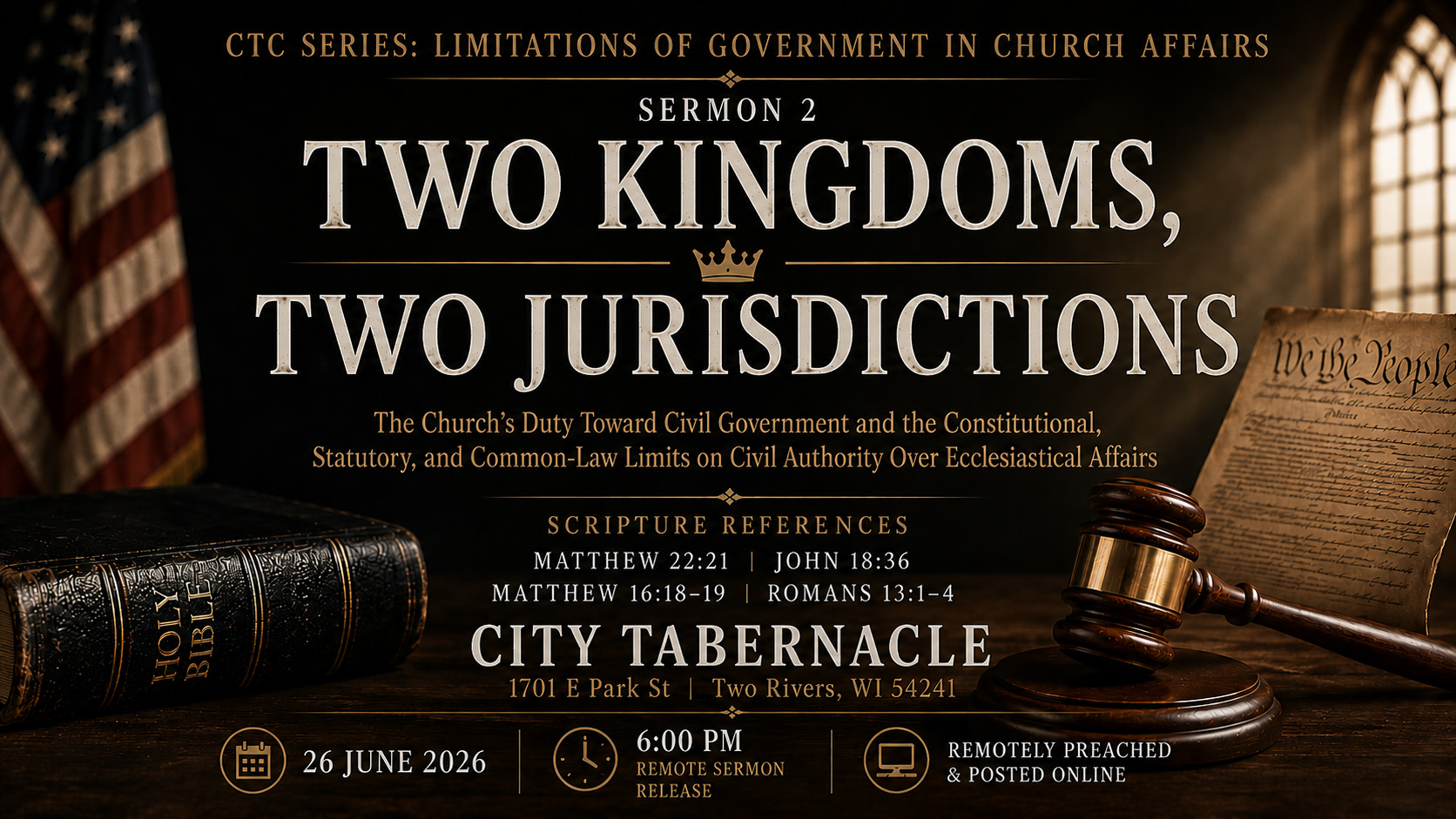
Sermon Two: Two Kingdoms, Two Jurisdictions
The message teaches that God has ordained distinct spheres of authority for the family, the church, and the civil magistrate. Building upon the truth that God alone is Lord of the conscience, this sermon asks: Who has authority over what? Christ gives His Church the keys of the kingdom, while the magistrate bears the sword for temporal justice. Liberty is preserved when each institution remains within its God-given jurisdiction, and tyranny begins when delegated authority pretends to be sovereign.
Topic Outline:
- God Governs Through Distinct Institutions
- Christ’s Kingdom and Earthly Kingdoms
- The Keys and the Sword
- Jurisdiction and Institutional Competency
- Sphere Sovereignty and Delegated Authority
- The Sin of Jurisdictional Usurpation
- Constitutional Limits on Civil Power
- Mutual Duties of Church and Magistrate
- When Jurisdictions Collide
- Ordered Liberty Under Christ
THE CHURCH AND CIVIL GOVERNMENT
Sermon Two of Twenty-One
TWO KINGDOMS, TWO JURISDICTIONS
Texts: ; John 18:36; Matthew 16:18–19; Romans 13:1–4
Preached Remotely 26 JUN 2026 | City Tabernacle | 1800
David J Cro, Pastor
————————————————————————
The question before us is not whether God alone is Lord of The Conscience. That foundation has already been laid. The question now before us is narrower, yet no less necessary: Who possesses authority over what? If the conscience belongs unto God, then we must next discern the boundaries of the earthly authorities beneath which men live.
The peace of nations, the liberty of churches, and the order of common life depend upon that question. Much tyranny has entered the world not because men denied authority altogether, but because they placed authority where God had not placed it. Some have given unto Caesar what belongs unto God. Others have given unto the church what belongs unto the magistrate.
Our Lord gave the principle enduring form when He answered those who sought to entangle Him with the coin of Caesar: “Render to Caesar the things that are Caesar’s, and to God the things that are God’s” (Matthew 22:21, ESV). Christ did not abolish Caesar, nor did He enthrone Caesar over all things. He acknowledged real civil authority while denying its universality. There are things that belong to Caesar, and there are things that belong to God.
This sermon therefore concerns jurisdiction, delegated authority and the difference between stewardship and sovereignty. It is not a plea for civil disorder, for the magistrate is ordained of God. Genesis 1:1-18; Psalm 104:5-9; Romans 13:1-7.
From the beginning, God established order by distinction. He divided light from darkness, waters from waters, land from sea, and day from night. Creation itself bears witness that distinction is not hostility and order is not oppression. To distinguish one thing from another is not to dishonor either, but to recognize the wisdom of the One who appointed each to its place. Genesis 1:1-18; 1 Corinthians 14:33.
Before there were kings, councils, courts, or nations, there was the family. Marriage was ordained in Eden, not by parliament, prince, or popular vote, but by God Himself. The household is therefore not a creature of the state, nor does parental authority arise from civil permission. Father and mother receive their charge from the Creator, and children are entrusted first to the household before they are ever known to the magistrate. Genesis 2:18-24; Deuteronomy 6:6-9; Ephesians 6:1-4.
After the flood, when violence had filled the earth, God established the civil magistrate as a minister of public justice. The sword was not entrusted to government that the state might save souls, define doctrine, or command worship, but that evildoers might be restrained and the innocent protected. “Whoever sheds the blood of man, by man shall his blood be shed, for God made man in his own image” (Genesis 9:6, ESV). Thus the magistrate is not an idol to be worshiped, nor a necessary evil to be despised, but an ordinance of God for temporal justice. Genesis 9:5-6; Romans 13:1-7; 1 Peter 2:13-14.
In the fullness of time, Christ established His church upon the confession of His name and commissioned her to preach the Gospel, baptize disciples, teach obedience to His commandments, administer discipline, and shepherd the flock purchased by His blood. Her authority is real, but it is spiritual. Her mission is public, but it is not civil. She may shape nations by truth, but her power is not the power of the sword. Matthew 16:18-19; Matthew 28:18-20; Acts 20:28; Ephesians 4:11-13.
These institutions are not enemies, nor are they interchangeable. The family, the church, and the magistrate are fellow servants under one God. They serve the same Lord, but they do not possess the same office. They may all instruct in righteousness, but not by the same authority.
Herein lies one of the great errors of modern life. Men often suppose that if a thing is good, government may command it; if a thing is harmful, government may regulate it; if a thing is difficult, government may manage it; if a thing is neglected, government may assume it. But moral importance does not itself create civil jurisdiction. A child’s soul is important, yet the state is not the father.
The question must always be asked: To whom has God entrusted this duty? Without that question, good intentions become instruments of disorder. The magistrate may desire virtue, yet he cannot regenerate the heart. The church may desire justice, yet she cannot lawfully wield the sword.
When the Son of God came into the world, He did not come as a revolutionary prince seeking the throne of Caesar, nor as a tribal liberator taking up arms against Rome. He came as the promised King, yet His kingdom was of another order. Men commonly measure authority by visible force. They look for armies, decrees, treasuries, prisons, and crowns.
After He fed the multitude, the people desired to take Him by force and make Him king. Our Lord withdrew. He who possessed all authority refused to receive a crown on the terms of popular excitement. He who made the nations would not establish His kingdom by mob enthusiasm or political seizure. John 6:15.
Before Pilate, the distinction became unmistakable. Jesus said, “My kingdom is not of this world. If my kingdom were of this world, my servants would have been fighting” (John 18:36, ESV). He did not deny that He was King. John 18:36; John 19:11.
The kingdoms of this world preserve themselves by force. They maintain borders, punish criminals, levy taxes, and command outward conduct. These powers are lawful when exercised within their appointed sphere. But Christ’s kingdom advances by truth, repentance, faith, preaching, baptism, discipline, and the power of the Holy Spirit. Zechariah 4:6; John 4:23-24; Romans 10:17; 2 Corinthians 10:3-5.
When Peter drew the sword in Gethsemane, thinking perhaps to defend the Lord by force, Jesus rebuked him: “Put your sword back into its place. For all who take the sword will perish by the sword” (Matthew 26:52, ESV). The rebuke was not a denial of lawful civil power, for Scripture elsewhere affirms that the magistrate bears the sword as God’s servant. It was a denial that the church’s mission may be carried forward by the sword. Matthew 26:52; Romans 13:4.
Here the distinction between the two kingdoms begins to shine with clarity. Christ reigns over both, but He administers them differently. He rules the civil order providentially and morally, ordaining magistrates for justice and peace. He rules His church redemptively and spiritually, gathering His people by Word and Spirit.
Whenever this distinction is denied, ruin follows. If the church takes up the sword as the instrument of faith, she corrupts her mission. If the state seizes the keys as the instrument of civil order, it becomes a false church. If rulers imagine themselves shepherds of souls, persecution follows.
The difference between these jurisdictions appears most clearly in the instruments Christ has entrusted to His church and those God has entrusted to the magistrate. Instruments are never accidental. They reveal the nature of the office, the purpose of the authority, and the boundary beyond which that authority may not pass. The plow belongs to the farmer, the scales to the merchant, the rod to the parent, the keys to the church, and the sword to the magistrate.
Concerning the civil ruler, the apostle declares that “he is the servant of God, an avenger who carries out God’s wrath on the wrongdoer” (Romans 13:4, ESV). The sword signifies coercive civil authority. It is the lawful power to restrain evil, punish crime, defend the innocent, and preserve public order. Such authority is not evil in itself, nor is it beneath Christian respect. Genesis 9:5-6; Romans 13:1-7; 1 Peter 2:13-14.
Yet the magistrate, though entrusted with the sword, has not been entrusted with the keys. He may punish theft, but he cannot forgive sin. He may enforce contracts, but he cannot administer baptism. He may regulate the civil use of property, but he cannot determine the doctrine preached from the pulpit.
Unto the church, Christ entrusted another instrument. He said, “I will give you the keys of the kingdom of heaven” (Matthew 16:19, ESV). These keys signify real spiritual authority, but not civil coercion. Through preaching, ordinances, and discipline, the church declares the terms of entrance into the kingdom, receives those who profess faith, admonishes the unruly, restores the penitent, and excludes the impenitent from visible fellowship. Matthew 18:15-20; John 20:21-23; 1 Corinthians 5:1-13.
The church therefore may bind and loose according to the Word of Christ, but she may not imprison. She may reprove sin, but she may not wield the penal sword. She may excommunicate, but she may not confiscate. Her weapons are not weak because they are spiritual; they are mighty precisely because they belong to God.
The sword was never intended to perform the work of the keys, and the keys were never intended to assume the office of the sword. The magistrate may compel, but he cannot convert. The church may persuade, but she cannot punish as the state punishes. When the sword attempts to convert, persecution follows.
Here, then, is a principle of enormous consequence: the office determines the instrument, and the instrument reveals the jurisdiction. If God has given the sword to the magistrate, then the magistrate is competent for civil justice. If Christ has given the keys to the church, then the church is competent for spiritual governance. But neither may lawfully seize what has been entrusted to the other.
Because God has entrusted different instruments to different institutions, it follows that He has entrusted different competencies to them as well. Authority in one sphere does not create jurisdiction in another. This truth is easily confessed in simple matters and frequently denied in matters of power. A man who is an excellent physician is not thereby made a judge.
Our generation is especially tempted to confuse expertise with jurisdiction. If an official can measure, he assumes he may command. If an agency can study, it assumes it may govern. If a court can reason, it assumes it may define.
The father possesses competency within the household because children have been entrusted to his care. The minister possesses competency in spiritual matters because he is called to labor in the Word and doctrine. The magistrate possesses competency in civil justice because the sword has been committed to him. But these competencies do not flow into one another as though all authority were a single river. Romans 12:3-8; Ephesians 4:11-12; 1 Timothy 5:17; James 3:1.
Such limitations do not diminish the dignity of office; they preserve it. A magistrate is more honorable when he administers justice than when he presumes to govern the church. A minister is more honorable when he preaches Christ than when he covets the authority of princes. A father is more honorable when he orders his household in the fear of God than when he seeks authority over households not entrusted to him.
This principle is essential to liberty. Because no institution possesses universal jurisdiction, no institution may rightly claim universal allegiance. The family, the church, and the state may each address the same person, yet they do so by different offices and for different ends. The child is a son in the household, a citizen before the magistrate, and a member of the church under the shepherding care of Christ’s appointed ministry.
The modern state is often tempted to become father, pastor, teacher, physician, employer, benefactor, moral instructor, and final judge of all disputes. Yet the enlargement of administrative power does not enlarge divine commission. The fact that government can do many things does not mean that God has authorized it to do all things. The ability to regulate is not the same as the authority to rule.
Likewise, the church must resist the temptation to become an earthly political machine. She may speak prophetically to rulers, teach righteousness to her people, and bear witness to justice in the public square. But she must not forget that her calling is Word, sacrament, discipline, prayer, and discipleship. When the church seeks influence by abandoning her spiritual weapons, she does not become stronger.
Families too must remember their office. Parents cannot surrender every duty to the state and then complain when the state governs what it has been invited to administer. Duties abandoned become powers transferred. When households cease to instruct, discipline, cultivate virtue, and bear responsibility for their own, they create the vacuum into which bureaucratic authority naturally expands.
Thus, jurisdictional wisdom begins with a question too seldom asked: To whom has God entrusted this duty? If that question is neglected, good intentions become instruments of disorder. If it is remembered, authority remains a blessing rather than a curse. For the family possesses authority because God delegated it.
We now arrive at a principle without which neither Christian theology nor constitutional liberty can be rightly understood: sovereignty, in the absolute and unrestricted sense, belongs to God alone. Men may speak of sovereign nations, sovereign states, or sovereign peoples, and within the language of civil law such terms may have their proper and limited use. Yet if we speak with theological precision, there is but one absolute Sovereign, one supreme Lawgiver, one King whose authority is original, underived, universal, and without limit. “The LORD has established his throne in the heavens, and his kingdom rules over all” (Psalm 103:19, ESV).
Every authority among men is therefore derivative. Kings rule because God permits them to rule. Judges judge because God has ordained the office of public justice. Parents govern because children have been entrusted to their care. Daniel 2:21; John 19:11; Romans 13:1-2; 1 Peter 5:1-4.
This truth guards us against every form of absolutism. If authority originates in man, then man may enlarge it according to his ambition. If authority originates in the state, then the state may define its own limits. If authority originates in the church as an earthly institution, then ecclesiastical rulers may claim dominion beyond the Word of Christ.
The family, the church, and the magistrate therefore stand side by side beneath God, not one as the source of the others. The state did not create the family. The family did not create the church. The church did not create the civil magistrate. Each has its own appointment from God, its own office, its own duties, its own instruments, and its own limits. The father answers directly unto God for his household. The pastor answers unto Christ for the flock. The magistrate answers unto heaven for justice and public order. None may absorb the others without violating the wisdom of the One who established them all.
Here the doctrine sometimes called sphere sovereignty becomes useful, provided it is understood not as a fashionable abstraction, but as a truth rooted in the government of God. Each sphere possesses a real authority under God within its proper jurisdiction. The household has authority over household matters. The church has authority over ecclesiastical matters.
A child, for example, may stand under the instruction of his parents, the teaching of the church, and the laws of the magistrate. Yet these authorities do not operate in the same manner. The parent disciplines as parent. The church admonishes as church.
The father is not sovereign. The pastor is not sovereign. The magistrate is not sovereign. The legislature is not sovereign. The court is not sovereign. The city is not sovereign. The state itself is not sovereign. God alone is sovereign. Every earthly authority is honorable only so long as it remains ministerial. Every office is dignified only so long as it remains obedient. Every institution is safe only so long as it remembers that it is a steward beneath the throne of God.
This arrangement is one of the great mercies of Providence toward mankind. Concentrated power is dangerous because fallen men are dangerous. The human heart, once entrusted with power, is seldom content to remain within limits. Pride seeks expansion.
God therefore distributes authority because He knows what is in man. He separates offices not because He delights in disorder, but because He restrains disorder by preventing the accumulation of unbounded earthly power. Liberty rests not upon the autonomy of man, but upon the sovereignty of God. Freedom is preserved not when every man becomes law unto himself, but when every office remains beneath the law of the Lord and within the jurisdiction assigned to it.
The greatness of an office, then, is not measured by the breadth of its control, but by the faithfulness with which it performs its appointed work. A magistrate is great when he administers justice without presuming to govern the church. A minister is great when he proclaims Christ without coveting the sword. A father is great when he orders his household in wisdom without imagining himself lord over all.
Thus, the principle of sphere sovereignty leads directly to the warning that must now be considered. If authority is delegated, then its abuse is not merely inefficiency or mismanagement; it is rebellion against the Giver of authority. If offices are bounded by God, then to trespass beyond those bounds is not merely administrative overreach; it is sin. Throughout Scripture and history, this sin appears again and again as one of the most destructive forces among men: the sin of jurisdictional usurpation.
If delegated authority is among the great blessings of God to mankind, then the violation of delegated authority is among the great sources of misery in human history. Sin itself is, in a profound sense, rebellion against jurisdiction. It is the creature refusing the bounds appointed by the Creator. It is the servant grasping at the throne of the Master.
Holy Scripture repeatedly records the ruin that follows when men transgress the boundaries of their office. The builders of Babel sought unity without obedience, power without submission, and a name for themselves apart from the name of God. They gathered their strength into one tower and one city, imagining that human consolidation could secure human greatness. Yet the Lord came down and scattered them, teaching the nations that power gathered against God becomes confusion, not glory. Genesis 11:1-9.
King Saul furnishes another solemn example. He was anointed to reign, but not to assume every sacred function. When fear and impatience overcame him before battle, he offered the sacrifice that belonged to the prophet’s office. Samuel’s rebuke was severe: “You have done foolishly.
The reign of Uzziah offers the same warning with still greater clarity. Uzziah was a king blessed with strength, prosperity, and renown. Yet when he became strong, his heart was lifted up to his destruction. He entered the temple to burn incense upon the altar, assuming a priestly function never entrusted to the crown. Azariah the priest withstood him and said, “It is not for you, Uzziah, to burn incense to the LORD, but for the priests” (2 Chronicles 26:18, ESV). Thus a ruler honored in his proper office was judged when he seized an office that was not his. The crown did not confer the priesthood. Civil dignity did not abolish spiritual boundaries. 2 Chronicles 26:16-21.
Nebuchadnezzar also had to learn that sovereignty belongs to God alone. Looking upon Babylon in the height of imperial glory, he said, “Is not this great Babylon, which I have built by my mighty power?” (Daniel 4:30, ESV). While the words were still in his mouth, judgment fell, and the great king was humbled until he learned “that the Most High rules the kingdom of men” (Daniel 4:32, ESV). Power may build cities, command armies, and fill treasuries; yet all power remains beneath the throne of God.
These biblical judgments reveal that jurisdictional usurpation is no small offense. It is not mere administrative confusion. It is spiritual rebellion. To claim authority God has not given is to bear false witness concerning God’s order.
The same sin appears throughout history. The Caesars of Rome did not content themselves with civil obedience. They demanded religious honor. They sought incense as well as tribute, worship as well as taxation.
Ecclesiastical ambition has proven no less dangerous. There have been seasons when churchmen, forgetting the spiritual character of Christ’s kingdom, sought dominion by the instruments of earthly power. Institutions established for preaching, sacrament, discipline, and shepherding became entangled with the ambitions of princes. Yet whenever the church covets the sword, she weakens the witness of the keys. Matthew 20:25-28; 2 Corinthians 10:3-5.
Royal supremacy has displayed the opposite error. Civil rulers, seeking to free themselves from ecclesiastical control, have often claimed authority over doctrine, worship, ordination, and church government. The sword, rejecting the tyranny of misused keys, then presumed to wield the keys itself. Thus one usurpation answered another, and the church suffered under the dominion of princes.
Every age produces its own idols. In one generation the idol wears a crown. In another, ecclesiastical robes. In another, it appears beneath party banners, administrative agencies, expert commissions, and bureaucratic decrees.
Modern statism may be the most expansive form of jurisdictional usurpation yet conceived. Earlier tyrannies often demanded obedience of the body; modern systems frequently seek authority over education, speech, conscience, livelihood, family, association, worship, and thought itself. The state becomes provider, instructor, guardian, physician, employer, moral tutor, and final judge. It promises security and gradually claims lordship.
Nor should the church speak of this danger as though she herself were immune from temptation. When congregations abandon preaching for permanent political agitation, when ministers become party captains rather than heralds of Christ, when the pulpit measures faithfulness by influence rather than truth, the church forgets her jurisdiction. The church may and must speak the Word of God to every sphere of life, including rulers and nations. But she must speak as church, not as state; with the authority of Scripture, not with the coercion of the sword.
Families also may participate in this disorder. When parents neglect instruction, discipline, and moral formation, they create the vacuum into which the state gladly enters. Duties abandoned become powers transferred. A people that will not govern its households should not be surprised when distant authorities offer to govern them.
Thus the sin of jurisdictional usurpation is not confined to kings, courts, popes, presidents, councils, or agencies. It belongs to every institution that despises the limits of its office. It appears whenever the state claims to be savior, whenever the church grasps for the sword, whenever the family rejects divine law, and whenever any human authority treats stewardship as sovereignty.
Against all such pretensions stands the Word of the Lord: “For the LORD is our judge; the LORD is our lawgiver; the LORD is our king; he will save us” (Isaiah 33:22, ESV). Judges are not the supreme Judge. Legislators are not the ultimate Lawgiver. Kings are not the eternal King.
The principles thus far established by Scripture are not confined to private theology. They have also shaped, however imperfectly, the constitutional order under which we live. A constitution does not create the moral universe. It does not call authority into existence from nothing.
The American constitutional order bears witness to this principle in its very structure. Powers are enumerated. Offices are divided. Ambition is checked by ambition.
Nowhere is this more evident than in the First Amendment. Its religion clauses are often treated in modern discourse as though their principal purpose were to drive religion out of public life. But such a reading mistakes jurisdictional limitation for secular hostility. The amendment declares that Congress shall make no law respecting an establishment of religion, or prohibiting the free exercise thereof.
This is not the exile of God. It is the limitation of Caesar. The First Amendment denies to civil government authority over those matters Christ entrusted to His church and those duties God left to the conscience under His Word. Congress may not prescribe worship.
The courts of the United States have repeatedly recognized this distinction, often under the doctrine called ecclesiastical abstention or church autonomy. In Watson v. Jones (1872), the Supreme Court recognized that civil courts must not decide questions of doctrine, discipline, or internal church government. In Kedroff v.
The same principle was powerfully reaffirmed in Hosanna-Tabor Evangelical Lutheran Church and School v. Equal Employment Opportunity Commission (2012), where the Supreme Court unanimously recognized the ministerial exception. In Our Lady of Guadalupe School v. Morrissey-Berru (2020), the Court further recognized that religious institutions must retain authority over those entrusted with transmitting the faith.
The principle remains unchanged whether one speaks of Washington, Madison, Manitowoc County, or the smallest municipality in Wisconsin. Federal governments possess delegated powers. States possess delegated powers. Counties possess delegated powers. Cities possess delegated powers. School boards possess delegated powers. Administrative agencies possess delegated powers. Assessors possess delegated powers. None possesses inherent sovereignty. None possesses jurisdiction over doctrine, worship, ordination, church discipline, ecclesiastical membership, or the spiritual government of Christ’s church. Such things belong to Christ and His kingdom.
Wisconsin’s own constitutional order bears witness to religious liberty and the rights of conscience, not because the state created these liberties, but because the state must recognize that they precede civil authority. The magistrate may protect churches in their civil rights, enforce neutral laws where jurisdiction properly exists, and punish crimes committed by religious persons. But he may not sit in judgment upon the truth of doctrine, the validity of ordination, the purity of worship, or the internal discipline of the church. Those questions belong to the keys, not the sword.
Thus, constitutional government at its best reflects the same wisdom Scripture teaches: authority is real, but it is limited; government is honorable, but it is not sovereign; civil power is necessary, but it is not universal. When the state remembers this, it serves as a minister of justice. When it forgets this, it becomes a rival priesthood, presuming to rule what God has not placed beneath its hand.
Yet distinction must never be mistaken for hostility. Because church and magistrate possess different jurisdictions, some imagine they must exist as enemies. Others suppose that if the state may not govern the church, then the church must remain silent concerning public righteousness. Both errors must be rejected.
The church owes honor to lawful civil authority. Paul wrote to believers living under Rome, “Let every person be subject to the governing authorities” (Romans 13:1, ESV). Peter likewise commanded, “Honor everyone. Love the brotherhood. Jeremiah 29:7; Romans 13:1-7; 1 Timothy 2:1-2; Titus 3:1; 1 Peter 2:13-17.
At the same time, the magistrate owes duties unto God. Civil rulers are not morally neutral functionaries. “Now therefore, O kings, be wise; be warned, O rulers of the earth. Serve the LORD with fear” (Psalm 2:10-11, ESV). Psalm 2:10-12; Proverbs 8:15-16; Romans 13:3-4.
Nevertheless, the magistrate serves God in his own office, not by invading the church’s office. He best honors religion not by governing doctrine, but by protecting the church’s liberty to obey Christ. He best serves truth not by writing creeds, but by administering justice impartially. He best acknowledges God not by pretending to be the church, but by remaining a humble minister of civil order beneath the law of God.
The church likewise blesses society most when she remains the church. She need not become a political machine to influence the world. She transformed the Roman Empire without legions. She civilized nations by preaching, teaching, charity, discipline, and worship.
This does not mean the church is silent in the face of public evil. John the Baptist reproved Herod. Nathan rebuked David. Elijah confronted Ahab.
The magistrate and the church therefore possess mutual duties without possessing the same jurisdiction. The magistrate protects civil order so the church may live peaceably and godly. The church prays for the magistrate, teaches righteousness, forms citizens in virtue, and reminds rulers that they too must answer to God. When each remains faithful to its office, society is blessed.
Joseph served faithfully under Pharaoh. Daniel served in Babylon without ceasing to pray to the God of Israel. Nehemiah labored under Persian authority while rebuilding Jerusalem. Paul appealed to Caesar while proclaiming another King, even Jesus. Genesis 41:37-44; Daniel 6:10; Nehemiah 2:1-8; Acts 25:10-12.
Thus the two jurisdictions are distinct, but they are not atheistic compartments. Christ is Lord over both. The magistrate answers to Him as magistrate. The church answers to Him as church.
Yet because rulers are fallen men, occasions arise when jurisdictions collide. The magistrate, ordained for justice, may command what God forbids or forbid what God commands. The church, ordained for truth, may be tempted either to surrender her commission for peace or to confuse faithful witness with worldly agitation. The family, ordained for nurture and discipline, may be pressured to yield duties God never placed in the hands of the state.
The ordinary posture of the Christian toward civil authority is not resistance, but submission. Scripture is plain. “Let every person be subject to the governing authorities” (Romans 13:1, ESV). The Christian is commanded to honor rulers, pay what is owed, pray for those in authority, live peaceably insofar as it depends upon him, and seek the welfare of the city in which Providence has placed him. Jeremiah 29:7; Romans 12:18; Romans 13:1-7; Titus 3:1; 1 Peter 2:13-17.
Nevertheless, civil authority is not absolute. When rulers command disobedience to God, the Christian must obey God. This is not lawlessness; it is the highest form of ordered obedience. When the apostles were commanded to cease preaching in the name of Christ, Peter and the apostles answered, “We must obey God rather than men” (Acts 5:29, ESV).
Daniel displayed the same spirit. When the decree forbade prayer to any god or man except the king, Daniel did not organize a rebellion, curse the ruler, or seek disorder in the streets. He simply continued to pray as he had done before, and he accepted the lions’ den rather than surrender obedience to God. The Hebrew youths before Nebuchadnezzar likewise refused to bow before the golden image. Daniel 3:16-18; Daniel 6:10.
Here is the pattern of faithful resistance. It is humble, not arrogant. It is obedient to God, not addicted to controversy. It suffers rather than sins.
The early Christians understood this distinction. They prayed for emperors, paid taxes, obeyed lawful commands, and lived as peaceable citizens. Yet when commanded to offer incense to Caesar as divine, they refused. They did not deny Caesar’s office.
This same principle remains necessary in every generation. A legislature may regulate civil affairs, but it may not command the church to deny Christ. A court may decide property disputes by neutral principles, but it may not determine which doctrine is true. A city may enforce ordinary safety laws within its lawful sphere, but it may not make itself overseer of worship, ordination, membership, discipline, or the preaching of the Word.
Therefore the church must cultivate both submission and courage. Submission without courage becomes servility. Courage without submission becomes rebellion. The Christian must be prepared to obey rulers in lawful things and to suffer peacefully when obedience to rulers would require disobedience to God. Acts 16:37-39; Acts 22:25-29; Acts 25:10-12.
Thus, when jurisdictions collide, the first question is not what do we prefer, nor what do we fear, nor what do we resent. The first question is: What has God commanded, and to whom has God entrusted this authority? If Caesar commands what belongs to Caesar, let Caesar be obeyed. If Caesar claims what belongs to God, let Caesar be respectfully refused.
For the preservation of liberty requires more than constitutions. It requires a people who understand authority. It requires churches that know their commission, families that discharge their duties, magistrates that fear God, and citizens who can distinguish submission from surrender. Without such wisdom, rights become slogans, law becomes machinery, and liberty becomes a memory.
We have considered together the two kingdoms and the jurisdictions appointed by God. We have seen that authority is not evil, but neither is it unlimited. We have seen that the family, the church, and the magistrate are not inventions of man, but ordinances of God. We have seen that each possesses real dignity because each receives real authority, and that each possesses real limits because each authority is delegated.
The question that has governed this sermon has been simple: Who possesses authority over what? The answer is the foundation of ordered liberty. The family possesses the authority of the household, but not the sword of the magistrate nor the keys of the church. The church possesses the keys of the kingdom, but not the penal sword nor the civil treasury.
When these boundaries are honored, society is blessed. Families nurture children in the fear of God. Churches proclaim the Gospel with courage and purity. Magistrates punish evil and praise good.
But when boundaries are despised, disorder follows. The father becomes a tyrant. The minister becomes a prince. The magistrate becomes a priest.
Therefore let rulers govern with humility. Let judges judge with fear. Let legislators remember that they do not create righteousness. Let city councils, counties, agencies, assessors, and officers remember that their powers are delegated and bounded.
For constitutions shall pass away. Legislatures shall pass away. Courts shall pass away. Cities shall pass away.
“His dominion is an everlasting dominion, and his kingdom endures from generation to generation” (Daniel 4:34, ESV).
Therefore let every institution remember that it is but a steward beneath the crown rights of King Jesus. Above every throne stands another Throne. Above every crown rests another Crown. Above every kingdom shines another Kingdom.
Amen.
REFERENCES
Holy Scripture
- English Standard Version (ESV)
- Genesis 1:1-18; 2:18-24; 3:1-6; 9:5-6; 11:1-9.
- Deuteronomy 6:6-9.
- 1 Samuel 13:8-14.
- 2 Chronicles 26:16-21.
- Psalm 2:10-12; 103:19; 104:5-9.
- Proverbs 8:15-16.
- Isaiah 33:22.
- Jeremiah 29:7.
- Daniel 2:21; 3:16-18; 4:30-34; 6:10.
- Matthew 16:18-19; 18:15-20; 20:25-28; 22:21; 26:52; 28:18-20.
- John 4:23-24; 6:15; 18:36; 19:11; 20:21-23.
- Acts 5:29; 16:37-39; 20:28; 22:25-29; 25:10-12.
- Romans 10:17; 12:3-8, 18; 13:1-7.
- 1 Corinthians 5:1-13; 14:33.
- 2 Corinthians 10:3-5.
- Ephesians 4:11-13; 6:1-4.
- 1 Timothy 2:1-2; 5:17.
- Titus 3:1.
- James 3:1.
- 1 Peter 2:13-17; 5:1-4.
- Zechariah 4:6.
Constitutional Authorities
- United States Constitution, Amendment I.
- United States Constitution, Amendment X.
- Wisconsin Constitution, Article I, Section 18.
- Wisconsin Constitution, Article I, Section 19.
United States Supreme Court Decisions
- Watson v. Jones, 80 U.S. (13 Wall.) 679 (1872).
- Kedroff v. Saint Nicholas Cathedral, 344 U.S. 94 (1952).
- Serbian Eastern Orthodox Diocese v. Milivojevich, 426 U.S. 696 (1976).
- Hosanna-Tabor Evangelical Lutheran Church and School v. Equal Employment Opportunity Commission, 565 U.S. 171 (2012).
- Our Lady of Guadalupe School v. Morrissey-Berru, 591 U.S. 732 (2020).
Historical and Theological Sources
- Althusius, Johannes. Politica Methodice Digesta. 1603.
- Blackstone, William. Commentaries on the Laws of England.
- Calvin, John. Institutes of the Christian Religion. 1559.
- Kuyper, Abraham. Sphere Sovereignty. 1880.
- Langdon, Samuel. Government Corrupted by Vice. Boston, 1775.
- Mayhew, Jonathan. A Discourse Concerning Unlimited Submission and Non-Resistance to the Higher Powers. Boston, 1750.
- Rutherford, Samuel. Lex, Rex: The Law and the Prince. London, 1644.
- Sandoz, Ellis, ed. Political Sermons of the American Founding Era, 1730-1805. 2 vols. Indianapolis: Liberty Fund, 1998.
- Story, Joseph. Commentaries on the Constitution of the United States.
- West, Samuel. On the Right to Rebel Against Governors. Boston, 1776.
- Witherspoon, John. The Dominion of Providence Over the Passions of Men. Princeton, 1776.
Worship Schedule
Schedule & Events
Please refer to our calendar for information ongatherings, teaching series, classes, and other special events.