
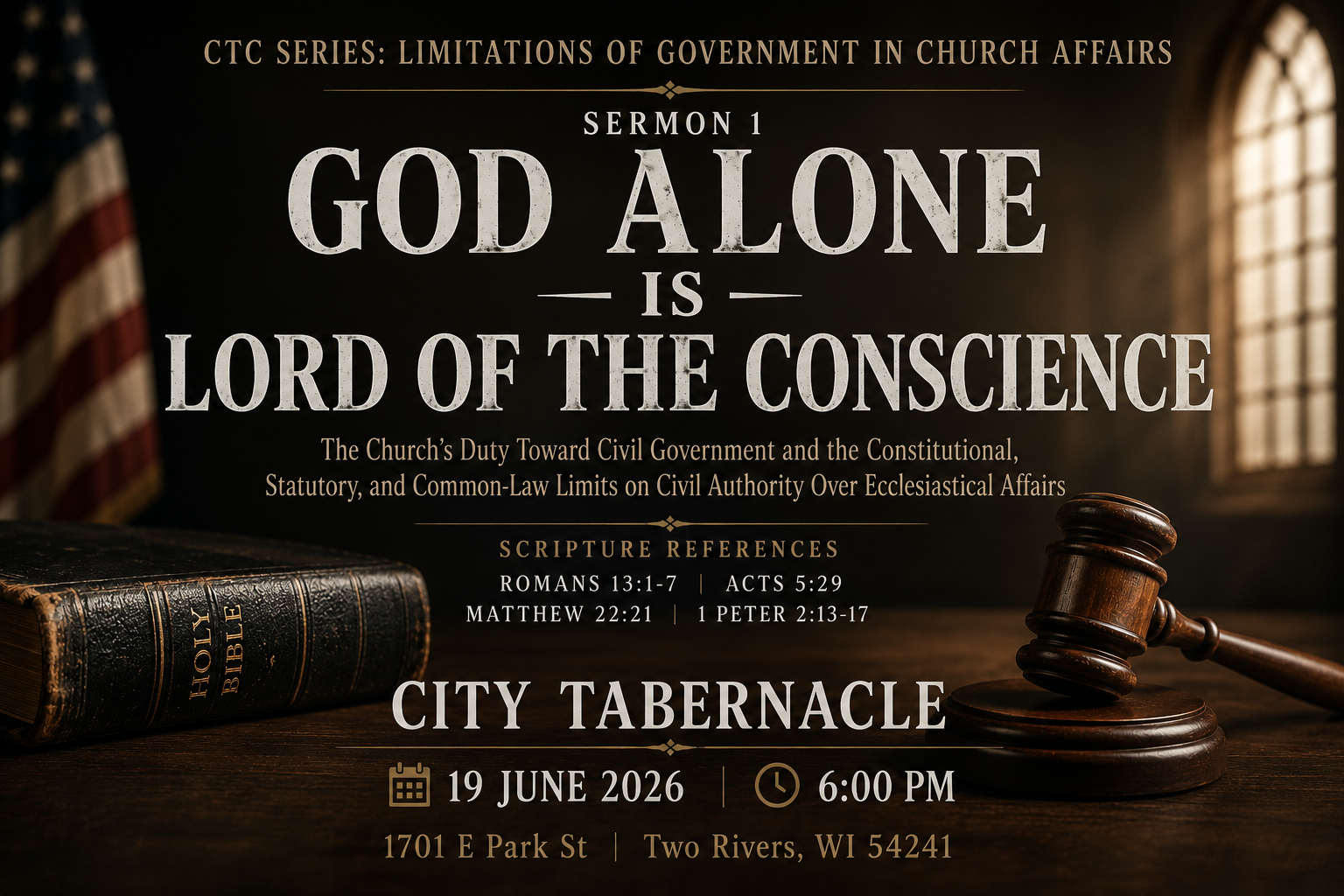
Sermon One: God Alone Is Lord of the Conscience establishes the foundational claim of the series: civil government is ordained by God but limited by God. The church must honor lawful authority, yet no magistrate may define worship, prescribe ministry, judge ecclesiastical legitimacy, or command the conscience. Christ alone is Head of the church, and civil authority may examine objective facts only within lawful jurisdiction, never becoming lord over doctrine, worship, schedule, ministry, or spiritual identity.
Topic Outline:
- Christ’s distinction between Caesar and God
- Civil authority as delegated, not sovereign
- Conscience as belonging to God alone
- Government’s limits over worship and ministry
- Biblical examples: apostles, Daniel, early Christians
- Augustine, Calvin, and Westminster on jurisdiction
- Constitutional protections: First Amendment and Wisconsin Article I, Section 18
- Church autonomy and key case law
- Pastoral exhortation to courage, humility, and lawful obedience
THE CHURCH AND CIVIL GOVERNMENT
Sermon One of Twenty-One
GOD ALONE IS LORD OF THE CONSCIENCE
Texts: Matthew 22:21; Acts 5:29; Romans 13:1-7; Galatians 5:1; James 4:12
Preached 19 JUN 2026 | City Tabernacle | 1800
David J Cro, Pastor
————————————————————————
Beloved brethren, this message is the first in a series of twenty-one sermons concerning the duty of the church toward civil government and the lawful limits of civil authority over the affairs of Christ’s church. Each message is intended to stand upon its own feet, so that the hearer who enters at the first sermon or the last may understand the principal doctrine before him; yet each also belongs to a larger design, and the whole series will carry more light than any single lamp can provide. We shall ask what Christians owe to magistrates, what magistrates owe to God, and what neither may seize from the other without disturbing the peace of society, violating the rights of conscience, or trespassing upon the crown rights of Jesus Christ.
Because this opening sermon lays the foundation rather than raising the entire house, several questions introduced here will receive fuller treatment later. Sermon Nine, ‘No Establishment and No Interference,’ will examine the civil prohibition against sponsoring, preferring, directing, or controlling religion. Sermon Fourteen, ‘Civil Regulation and Its Proper Limits,’ will consider when ordinances, taxation, codes, administrative standards, or official judgments concerning a ministry’s regularity, schedule, frequency, location, and form of worship become an unlawful decree concerning ecclesiastical practice. Sermon Fifteen, ‘The Free Exercise of Religion,’ will address the church’s liberty to worship, teach, assemble, serve, and order its ministry according to faith without discriminatory burden or civil coercion. Those later sermons will enlarge the subject; this one supplies the root from which they grow.
There are seasons in history when nations forget the boundaries established by God. Kings become priests, magistrates become bishops, and bureaucracies assume authority over matters which heaven has reserved unto Christ. At such times the church is tempted either to flatter power or to despise all authority. Scripture permits neither error. The God who ordained civil government also fixed its bounds, and the Christ who commands His people to honor rulers also forbids them to render unto Caesar what belongs unto God. We therefore begin with a proposition simple enough to be remembered by a child and weighty enough to make empires tremble: God alone is Lord of the conscience.
The conscience of man was never committed unto Caesar. It belongs unto Him who formed the soul, searches the heart, commands repentance, grants faith, and judges the secrets of men. Civil rulers possess a real office, but it is an office of limited jurisdiction. They may punish theft, violence, fraud, and public disorder; they may maintain roads, courts, records, and the outward peace of the commonwealth. They may regulate genuine civil harms through laws that are neutral, generally applicable, and honestly directed to public safety. Yet they may not command faith, define doctrine, appoint ministers, settle worship, prescribe or suggest the hour at which devotion becomes religious, determine how often a congregation must gather before it is deemed alive, or judge whether the form chosen by a church sufficiently resembles the magistrate’s preferred picture of ministry.
Every authority upon earth is derived authority. No president, legislature, court, mayor, council, assessor, inspector, or administrative agency possesses sovereignty inherently. Daniel declared that the Most High removes kings and sets up kings, and Paul taught that there is no power but of God and that the powers that be are ordained of God. The apostle did not thereby crown rulers as gods. He named them ministers. A minister receives a commission; he does not invent one. His office is honorable precisely because it is bounded. The river is not dishonored by its banks, nor is the magistrate diminished when he remains within the channel appointed for him. Authority becomes tyrannical only when it mistakes stewardship for ownership and jurisdiction for sovereignty. (Daniel 2:21; Romans 13:1-4)
Romans 13:1-7 must therefore be received in its full majesty and within its proper bounds. It is a strong wall against anarchy, for the ruler bears not the sword in vain. Yet it is also a wall against tyranny, because the ruler is called God’s minister for good. The text identifies both the source and the end of civil authority. Delegated power cannot be larger than the commission from which it comes, and an office ordained for good does not become righteous merely because an officer acts. The badge does not sanctify the trespass, and a decree may be procedurally issued and still exceed jurisdiction; a command may be clothed in legal form and still reach into a chamber the law has forbidden government to enter.
Our Lord set this distinction before us when the Pharisees and Herodians came with a coin and a snare. They asked whether tribute should be paid to Caesar, hoping either to make Him an enemy of Rome or to stain Him in the eyes of the people. Christ asked whose image and inscription the coin bore, and when they answered, “Caesar’s,” He said, “Render therefore unto Caesar the things which are Caesar’s; and unto God the things that are God’s” (Matthew 22:21). In that sentence the Lord neither abolished government nor consecrated the State as master of all things. He drew a boundary bright as morning. Caesar has a lawful portion, but he does not possess the whole field of human obligation.
The saying rebukes two opposite errors: To the zealot who would use religion as an excuse to refuse every civil burden, Christ says, “Render unto Caesar.” To the ruler who would turn taxation, licensing, inspection, or administration into title over the soul or ecclesiastical affairs, Christ says, “Render unto God.” The coin may bear Caesar’s image, but man bears the image of God. Government may ask whether a building is structurally safe; it may not declare or decree what schedule proves active worship or its sincerity. It may enforce a neutral fire code; it may not decree that ministry exists only when it follows a civil calendar. It may record the use of property for lawful civil purposes; it may not transform its own preference for weekly, visible, conventional services into an ecclesiastical test to satisfy governmental preferences. (Matthew 22:21; Genesis 1:26-27)
Here, then, is the first boundary: civil power may reach outward conduct within lawful jurisdiction, but it cannot become the lord of the heart or the architect of the church. It cannot forgive sin, awaken faith, regenerate the dead heart, administer the sacraments, call a pastor, ordain an elder, determine the proper season of fasting, or decide whether worship offered in a sanctuary, a home, a rented hall, a public place, or another lawful setting is spiritually genuine. Nor may it determine what worship is or is not. The sword can restrain the arm of the wrongdoer, but it cannot make the sinner new. The decree can command an outward act, but it cannot produce inward worship. When government forgets this, it becomes like a man holding a lantern at noon, supposing that because he possesses a little light he has become the creator of the sun.
Christ alone is Head of the church. Paul writes that “God has put all things beneath His feet” and that the Father “gave Him to be Head over all things to the church.” Not head among many heads, not chief among equals, but Head over all things. The church therefore has one monarch – one King. No emperor, congress, court, denomination, governor, city council, or administrative board may occupy His throne. Civil government does not create the church; it encounters her. It may recognize her civil existence, record her ownership, adjudicate genuinely civil questions, and protect her from violence, but it cannot breathe life into the body of Christ, and it cannot extinguish that life by declaring that ministry has failed to conform to a governmental model. (1 Corinthians 15:27; Ephesians 1:22)
This principle becomes especially important when officials are tempted to judge religion by appearances convenient to administration. A bureaucracy naturally desires visible categories: an altar, a sign, a familiar order of service, a congregation assembled every week at the same hour, a building continuously open, a schedule easily placed in a box. Yet the church of Jesus Christ has gathered in catacombs and cottages, in fields and prisons, in sanctuaries and schoolhouses, by riversides and beneath hostile skies. She has endured war, weather, poverty, sickness, persecution, broken buildings, scattered congregations, and long seasons in which the ordinary pattern of public assembly was hindered for whatever reason. Her circumstances may change without her Head changing; her schedule may be interrupted without her commission being revoked.
A magistrate may inquire into objective civil facts when law requires it, but he may not create a theology of regularity. He may ask whether a structure is occupied, whether a hazard exists, whether a deed conveys title, or whether a claimed use is supported by evidence. He may not say that the church is a church only if worship occurs at the times, in the place, with the frequency, and in the manner that he deems proper. The moment civil authority declares what iteration of worship is adequate, what schedule is sufficiently religious, or what interruption is fatal to ministry, it ceases merely to find facts and begins to issue an ecclesiastical decree. It has stepped over its natural God-given authority from measuring walls into measuring devotion.
This does not mean that the word “religion” dissolves every civil question. A church may be answerable for violence, fraud, abuse, unsafe structures, broken contracts, or other civil wrongs that can be judged without deciding doctrine. A sanctuary must never become a hiding place for sin, and church autonomy is not a cloak for negligence. Yet the distinction remains essential. Civil authority may regulate the smoke from a chimney; it may not dictate the incense of worship. It may require that an exit remain clear; it may not command when the people of God must enter. It may restrain a nuisance proved by neutral standards; it may not invent a preferred form of ministry and punish the church for departing from it.
What, then, is conscience? It is not appetite dressed in sacred language, nor preference crowned as revelation. Conscience is the inward witness by which a person apprehends himself accountable before God. It accuses, excuses, warns, and bears testimony. Yet conscience is not itself sovereign or infallible. It may be weak, defiled, misinformed, or seared. Paul once acted in good conscience while persecuting the early church; sincerity did not make persecution righteous. Conscience must therefore be instructed by Scripture, humbled by truth, and washed from dead works through Christ. The liberty of conscience is not freedom from God, but freedom under God.
For this reason Christian liberty is not self-will. It does not mean that every private impression carries the authority of Sinai, or that every inconvenience is persecution. It means that no human being may impose as divine law what God has not commanded, forbid as sin what God has permitted, or require a church to prove its spiritual authenticity by obeying a civilly preferred pattern of worship. The free conscience is not an untethered boat drifting wherever desire blows; it is a vessel anchored to the Word, able to resist the tides of fashion, fear, and power because its chain descends to rock.
The apostles displayed this liberty when the council commanded them to cease preaching in the name of Jesus. They did not deny magistracy; they denied the council’s jurisdiction over the command of Christ. Their answer, “We ought to obey God rather than men” (Acts 5:29), is the grammar of holy resistance. They did not resist because obedience was inconvenient, expensive, or unpopular. They resisted because compliance would have been sin. Their refusal was firm, public, and reverent. They did not seize the council chamber or summon an army. They accepted suffering rather than surrender obedience. Christian resistance begins not in wounded pride but in a conscience captive to the Word of God.
The same distinction appears in Daniel. He served pagan kings faithfully, interpreted dreams, administered public affairs, and bore no spirit of sedition. Yet when prayer was forbidden, he opened his window as he had done before to pray to God. Notice that the decree concerned time and practice. It attempted to govern when prayer might be offered and to whom devotion might be directed. Daniel did not permit the ruler’s calendar to become lord of his worship. He neither altered his devotion to satisfy the decree nor abandoned public faithfulness in civil duty. He rendered diligent service to the king while refusing the king’s claim upon the sanctuary of conscience. (Daniel 1:19-20; Daniel 2:19-45, 48-49; Daniel 4:19-27; Daniel 6:1-10)
The early Christians understood this. Rome tolerated many religions and could have tolerated Jesus as one more deity in a crowded pantheon. What it could not tolerate was the confession that Jesus Christ alone is Lord. Christians paid taxes, prayed for rulers, rescued the abandoned, cared for the poor, and sought to live peaceably. Yet they would not offer the pinch of incense that declared Caesar divine. The issue was not whether Rome possessed authority; the issue was whether Rome possessed authority over worship. The martyrs answered with their blood that it did not.
Augustine, looking upon the ruins and anxieties of the Roman world, distinguished the City of God from the earthly city, not to make Christians careless citizens, but to remind them that two loves produce two societies and two final ends. The earthly city seeks a peace suited to mortal life; the City of God journeys toward the peace of eternal communion with God. The two mingle in history, and Christians labor for justice within the temporal city, yet the pilgrim church never becomes merely a department of an earthly realm. Her citizenship is higher, her hope is longer, and her King is not elected, appointed, licensed, assessed, or dismissed by men.
Calvin likewise distinguished civil government, which preserves outward order, from spiritual government, by which Christ rules the conscience through His Word and Spirit. He did not set the two at war, for both stand beneath God; he set them in their proper rooms. The magistrate does not administer the sacraments, and the church does not wield the civil sword. When either invades the other’s office, harmony gives way to confusion, as music collapses when every instrument abandons its part and reaches for the conductor’s baton. A mayor cannot become an elder by ordinance, and a council cannot become a consistory by vote.
The Westminster divines gathered this biblical inheritance into a sentence that should be written upon the doorway of every church and within the conscience of every ruler: God alone is Lord of the conscience. They added that He has left it free from doctrines and commandments of men contrary to His Word, or beside it in matters of faith and worship. That confession protects the believer from two tyrannies at once: the tyranny of the State that would command religion, and the tyranny of religious leaders who would elevate their inventions to the throne of God. The church is free from Caesar in order to be bound to Christ.
We must therefore distinguish sovereignty from jurisdiction. Sovereignty is ultimate authority, and in the fullest sense it belongs to God alone. Jurisdiction is limited authority over an appointed person, place, subject, or controversy. We must also distinguish power from authority. Power is the capacity to act; authority is the right to act. A government may possess the practical power to close doors, deny recognition, impose penalties, delay permits, levy taxes, or exhaust a congregation through process while lacking moral or constitutional authority to decide how ministry must operate. Might can place a hand upon the latch; it cannot thereby make the trespass lawful.
These distinctions are not abstractions. They determine whether a public official is applying law or composing religion. Suppose an officer says that a ministry is genuine only if it holds public services every week, or only if worship occurs in one building, or only if a congregation follows a conventional pattern recognizable to the civil eye. Such a rule may be spoken softly, written administratively, or disguised as a neutral assumption; nevertheless, it functions as a decree concerning ecclesiastical life. It tells the church when to gather, where to gather, how often to gather, and what outward form must appear before government will acknowledge its religious character. Neither the United States Constitution nor the Wisconsin Constitution permits civil officers to occupy such an ecclesiastical office; indeed, such appointment is forbidden.
A church may gather regularly and should not use liberty as an excuse for disorder. The New Testament exhorts believers not to forsake assembling together, and faithful shepherds ought to cultivate public worship, instruction, fellowship, prayer, and the ordinances of Christ. Yet the duty belongs to Christ’s command and the church’s obedience, not to the creative authority of the municipality. The fact that Scripture commands worship does not transfer to government the power to define compliance. Civil rulers may protect the freedom to assemble; they may not become the keepers of the ecclesiastical clock. They may not set an edict in place of their own preferences. (Hebrews 10:25)
Nor does a temporary interruption erase the church. A congregation may be hindered by fire, failed heat, flood, illness, persecution, construction, displacement, pastoral scheduling conflicts or other providential hardship. It may gather in another location, in smaller groups, at altered times, or through forms adapted to necessity. Prudence may counsel one arrangement today and another tomorrow. Christ’s church has often survived precisely because she could move without surrendering her identity. The shepherd may lead the flock through a different gate when the familiar path is blocked, unavailable, or unsuitable for worship; the civil magistrate has no authority to declare the flock nonexistent because it did not stand where he expected to see it.
This is not an argument for secrecy or evasion. Churches should, communicate clearly, obey lawful safety rules, and provide objective evidence when civil law legitimately requires proof of a civil fact. But proof of a civil fact is not permission for the State to define a spiritual standard. Government may ask what occurred; it may not dictate what must occur as a condition of ecclesiastical legitimacy, or deem a legitimate or plausible excuse unreasonable or unacceptable. It may determine whether a building was used on a date; it may not infer that ministry ceased merely because worship took another form, moved to another place, followed another schedule, or continued through pastoral, charitable, educational, or devotional acts not convenient to bureaucratic measurement.
When this conviction crossed the Atlantic, it did not arrive in perfect form. Colonies sometimes repeated the establishments from which settlers had fled, and religious liberty matured through repentance as well as wisdom. Yet the seed took root. James Madison defended the full and equal rights of conscience, and the American constitutional order eventually placed enforceable restraints upon civil power. The First Amendment forbids government to establish religion or prohibit its free exercise. The Fourteenth Amendment carries those restraints against state and local power. The result is not a nation without religion, but government forbidden to compose, sponsor, direct, or suppress religious life.
I would add that the door through which government might presume to enter ecclesiastical affairs is firmly shut; civil authority does not cross the threshold of Christ’s sanctuary. Yet the church’s witness properly goes forth into the public square, declaring from the Word of God what is lawful, good, and just. The church may instruct, admonish, and bear moral testimony to rulers, but the State may not return through that door to govern worship, doctrine, ministry, or the conscience of Christ’s people.
Wisconsin speaks with particular force. Article I, Section 18 declares that “the right to worship Almighty God according to the dictates of conscience shall never be infringed and that no control of or interference with the rights of conscience shall be permitted.” These are not decorative words resting beneath glass in Madison. These words extend protection beyond what the First Amendment forbids. They address every public office in the State. A county, city, village, assessor, board, commission, or agency possesses only the authority granted by law, and every such grant is bounded by the Constitutions of Wisconsin and the United States. Local government is near enough to touch daily life, but nearness does not enlarge jurisdiction.
The American courts have often described this restraint through the doctrine of church autonomy. In Watson v. Jones, the Supreme Court warned civil judges away from deciding which faction was true to doctrine. In Kedroff v. St. Nicholas Cathedral, the Court struck down a state attempt to rearrange Orthodox church government. In Serbian Eastern Orthodox Diocese v. Milivojevich, it refused civil review of ecclesiastical decisions concerning a bishop and diocesan structure. The cases differ in detail, but their lesson is one: Caesar’s bench is not an appellate court over Christ’s house.
The ministerial-exception cases guard another doorway. Hosanna-Tabor held that government may not use employment law to control a church’s choice of those who minister in its name. Our Lady of Guadalupe emphasized religious function rather than titles alone, recognizing that the transmission of faith may be carried by teachers and others whose service is woven into a religious mission. Wisconsin’s Coulee Catholic Schools decision applied the same jurisdictional insight. If the State may dictate who carries the message, it governs the pulpit without climbing its steps; if it may dictate the pattern by which the message must be carried, it governs worship without opening the hymnal.
The Supreme Court’s decision in Catholic Charities Bureau v. Wisconsin Labor and Industry Review Commission further warned the State against constructing a theology of religious service. Wisconsin had treated charitable work as insufficiently religious because it did not proselytize, serve only co-religionists, or wear a particular outward form. The Court rejected that discrimination. The civil lesson is profound: government may not decide that ministry is religious only when it looks sufficiently sectarian to the State. Bread given in Christ’s name does not cease to be religious because no sermon is demanded as its price, and worship does not cease to be worship because hardship alters its hour or place.
Let us gather the principal definitions. Authority is the right to command within a lawful sphere. Power is the ability to act, whether lawfully or unlawfully. Jurisdiction is authority over a person, place, subject, or controversy committed to an office. Sovereignty is ultimate rule. Liberty is not the absence of all restraint, but freedom to fulfill duty under just order. Conscience is the inward witness of accountability to God. Church autonomy is the freedom of a religious body to govern matters of faith, doctrine, ministry, worship, discipline, mission, and internal order without civil domination. These words are not dry stones; set properly together, they form a wall around peaceful liberty.
There is an ordered beauty in the biblical arrangement. The Christian is not told to despise the magistrate, but to honor him. The church is not told to seize the sword, but to preach the Word. The ruler is not commissioned to administer sacraments, but to preserve civil peace. The family nurtures life; the church ministers grace; the magistrate restrains public wrong. All stand beneath one heaven, yet each labors in a distinct field. When each keeps its calling, authority becomes service and liberty becomes fruitful. When one sphere swallows the others, the garden of ordered life is trampled into a single hard road. (Romans 13:1-7; 1 Peter 2:13-17; 2 Timothy 4:2)
We return, then, to Christ’s coin. “Render unto Caesar the things that are Caesar’s, and unto God the things that are God’s” (Matthew 22:21). It is not enough to quote the first half when government demands obedience; one must remember the second half when government reaches beyond its commission. Nor is it enough for the church to invoke the second half while withholding what is lawfully Caesar’s. Christ’s sentence is a balance held by a perfect hand. It condemns both rebellion against lawful authority and servility before unlawful command.
Such firmness need not become bitterness. The church must not clothe pride in the language of conscience, confuse inconvenience with persecution, or make every disagreement a holy war. She should answer officials courteously, , honor lawful procedures, pay what is lawfully due, and seek peace wherever conscience permits. But courtesy is not surrender. There comes a point at which administrative expectation becomes ecclesiastical command, and concession becomes disobedience. At that point the church must speak plainly, appeal lawfully, endure patiently, and stand without malice.
There is therefore a duty on both sides of the boundary. The church must pray for rulers, teach obedience, expose injustice without becoming the servant of a political party, and refuse to purchase favor by muting the whole counsel of God. Government must protect public order without deciding theology, apply neutral laws without religious preference, and recognize that churches possess an identity not created by civil charter. The State may acknowledge the church as a legal entity for civil purposes; it does not breathe life into the body of Christ. A certificate may record what the law sees. It cannot create what heaven has called.
Let public officials hear this without hostility. The limitation of government is not contempt for government. A river is not dishonored by its banks; it is made useful by them. The magistrate is most noble when he remains a minister of justice and refuses the seduction of omnipotence. The official who recognizes that worship, doctrine, ministerial form, and the internal ordering of the church lie beyond his jurisdiction does not diminish his office; he preserves it, he honors it, he commands public respect. Humility before constitutional and divine limits is not weakness. It is the strength of lawful government.
Let pastors and churches examine themselves also. Have we taught our people to pray for magistrates as earnestly as we warn against tyranny? Have we distinguished civil disagreement from spiritual coercion? Have we ordered our ministries with honesty, accountability, and care? A church that asks government to respect its jurisdiction should labor to govern that jurisdiction faithfully. Neglect is not autonomy, disorder is not liberty, and secrecy is not holiness. The crown rights of Christ are not a cloak for ecclesiastical laziness; they are a summons to responsible obedience beneath His searching eye.
Let every hearer examine his own conscience. Is it truly bound to God, or merely to habit, party, fear, injury, or appetite? A man may shout liberty while enslaved to anger. Another may praise obedience because courage would cost him comfort. The faithful conscience is neither noisy nor cowardly. It is teachable before Scripture, quick to repent, slow to claim persecution, and immovable when obedience to Christ is plainly at stake. Before we ask whether Caesar has crossed the line, we should ask whether our own hearts have bowed to Christ – our King.
The sermons that follow will build upon this foundation. We shall consider prayer for rulers and honor for lawful authority; the distinction between ecclesiastical and civil jurisdiction; the reach of federal, state, county, municipal, and administrative power; church property, taxation, land use, public records, ministry, discipline, and the remedies available when lawful boundaries are crossed. The later messages will return repeatedly to this first truth, because every branch grows from this root: Christ is King, civil power is delegated, conscience belongs to God, and the church may not surrender to earth what heaven has entrusted to her keeping.
Therefore, beloved, do not think of conscience as a small and private chamber. It is the quiet sanctuary in which the creature knows himself seen by the Creator. Kingdoms may thunder outside its door. Statutes may multiply, officers may command, schedules may be imposed, forms may be demanded, and fear may whisper that surrender would be easier. Yet when the Word of God has spoken clearly, the conscience must stand captive not to whim, but to truth. The body may be fined, confined, wearied, or misunderstood; the church may pass through winters of obscurity; but no earthly hand can lawfully take the throne that belongs to God.
Let the church therefore render its duties faithfully without worship being hindered, honor the magistrate without worshiping power, seek peace without selling truth, and practice courage without bitterness. Let her doors remain open to the poor, her pulpit open to the whole counsel of God, her discipline just, her prayers full of mercy, and her conscience free. Let her worship in the times, places, and lawful forms that faith, providence, pastoral wisdom, as necessity require, remembering that Christ, not the magistrate, is Lord of her calendar, her mission, and her praise.
God alone is Lord of the conscience. Christ alone is Head of the church. The Spirit alone gives life. The magistrate bears a real sword, but not the keys of the kingdom. The church bears real keys, but not the civil sword. Let neither envy the other, let neither devour the other, and let both stand beneath the judgment of the One whose kingdom is everlasting and whose dominion passes not away. (Daniel 7:14)
May God grant His church wisdom without fear, courage without arrogance, obedience without servility, liberty without lawlessness, and peace without compromise. May He teach rulers to love justice and limits, pastors to love truth and humility, and citizens to honor both God and lawful authority. And when earthly commands collide with the clear command of heaven, may He give us grace to answer with reverence, patience, and unshaken faith: “We ought to obey God rather than men” (Acts 5:29).
Amen.
REFERENCES
- Matthew 22:21; Acts 5:29; Romans 13:1-7; Galatians 5:1; James 4:12; Genesis 1:26-27; Daniel 1:19-20; Daniel 2:19-45, 48-49; Daniel 2:21; Daniel 4:19-27; Daniel 6:1-10; Daniel 7:14; 1 Corinthians 15:27; Ephesians 1:22; Hebrews 10:25; 1 Peter 2:13-17; 2 Timothy 4:2. Scripture quotations and allusions are from the King James Version unless otherwise indicated.
- Augustine, The City of God, book XIV, chapter 28, distinguishing the earthly city and the City of God by their ruling loves and final ends.
- John Calvin, Institutes of the Christian Religion, book III, chapter 19, and book IV, chapter 20, distinguishing liberty of conscience and spiritual government from civil government.
- Westminster Confession of Faith, chapter 20, section 2: God alone is Lord of the conscience and has left it free from human doctrines and commandments contrary to His Word, or beside it in matters of faith or worship.
- U.S. Constitution, amendment I; amendment XIV.
- Wisconsin Constitution, article I, section 18.
- Watson v. Jones, 80 U.S. (13 Wall.) 679 (1872); Kedroff v. St. Nicholas Cathedral, 344 U.S. 94 (1952); Serbian Eastern Orthodox Diocese v. Milivojevich, 426 U.S. 696 (1976).
- Jones v. Wolf, 443 U.S. 595 (1979), recognizing neutral principles in church-property disputes when they can be applied without deciding ecclesiastical questions.
- Hosanna-Tabor Evangelical Lutheran Church & School v. EEOC, 565 U.S. 171 (2012); Our Lady of Guadalupe School v. Morrissey-Berru, 591 U.S. 732 (2020).
- Coulee Catholic Schools v. Labor & Industry Review Commission, 2009 WI 88, 320 Wis. 2d 275, 768 N.W.2d 868.
- Catholic Charities Bureau, Inc. v. Wisconsin Labor & Industry Review Commission, 605 U.S. 238 (2025).
- Religious Land Use and Institutionalized Persons Act of 2000, 42 U.S.C. sections 2000cc to 2000cc-5.
- The Declaration of Independence, paragraph 2 (1776).
- 1 William Blackstone, Commentaries on the Laws of England, Introduction, section 2 (1765).
Worship Schedule
Schedule & Events
Please refer to our calendar for information ongatherings, teaching series, classes, and other special events.